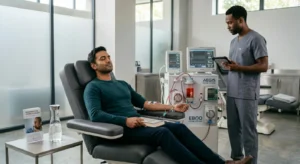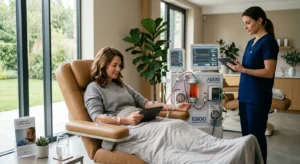
EBOO stands for extracorporeal blood oxygenation and ozonation. It is a procedure in which blood is drawn from a vein in one arm, passed through a sealed external circuit where it meets a filter and a measured oxygen and ozone mixture, then returned to a vein in the opposite arm. A session runs about 45 to 60 minutes. You sit awake in a chair the whole time.
That is the entire mechanism. Everything else on this page is context: what it is not, what the research does and does not show, where it stands with the FDA, and what a session at our clinic actually involves.
We have tried to write the page we wish had existed when patients started asking us about this. That means including the parts that are unflattering.
What EBOO is not
Most of the confusion around EBOO comes from three mix-ups.
It is not dialysis. The filter cartridge works on the same physical principle as a dialyzer, using thousands of hollow fibers with a semi-permeable wall, which is why EBOO is sometimes marketed as “ozone dialysis.” That name describes the hardware, not the purpose. Dialysis exists to do the work of failed kidneys, removing urea and correcting electrolytes in people who would otherwise die without it. EBOO is not doing that, does not replace it, and is not a treatment for kidney failure.
It is not a transfusion. No donor blood is involved. Your own blood leaves and comes back. Nothing is added to your circulation except the gas mixture and the anticoagulant needed to keep blood from clotting in the tubing.
It is not “oxygen therapy.” Ozone is O3, not O2. It behaves very differently in the body, and the therapeutic theory behind it is not “more oxygen.” The proposed mechanism is a mild, controlled oxidative signal: a small stress that the body responds to by upregulating its own antioxidant and immune machinery. That is a hypothesis with laboratory support, not a settled fact.
How the circuit works
The EBOO circuit. Blood leaves a vein in one arm, passes through a pump, a hollow-fiber filter cartridge and an oxygen and ozone mixing stage, then returns to a vein in the opposite arm.
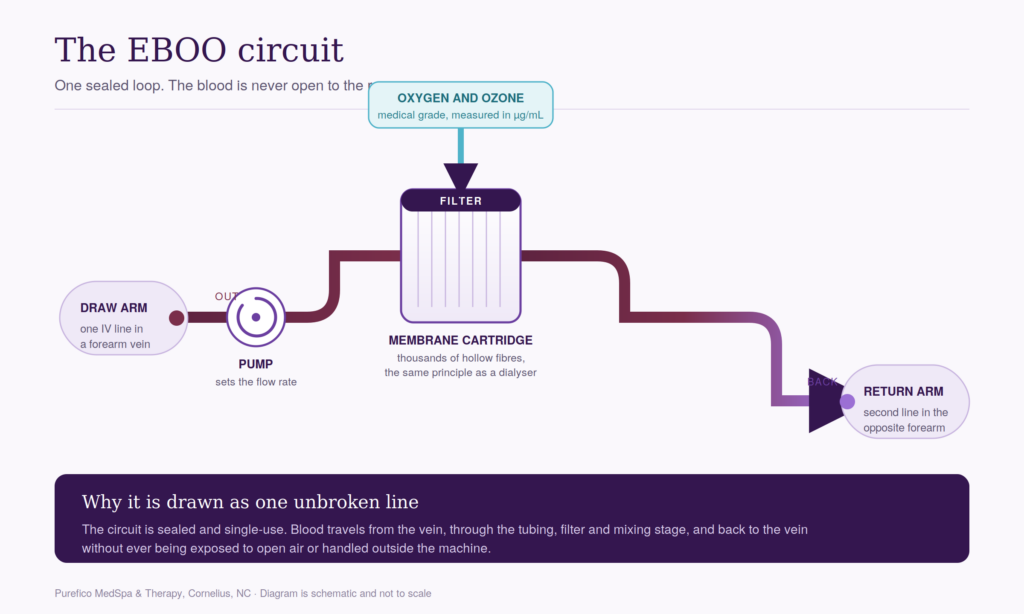
Two IV lines go in, one per arm. A pump moves blood out of the draw-side line at a controlled rate. The blood passes through a cartridge packed with hollow fibers, where the oxygen and ozone mixture is introduced across the membrane. It then travels back up the return line into the other arm.
The single most important structural fact is that the circuit is closed and single-use. Blood is never open to the room, never handled in a bowl or bag, never exposed to air. Patients often picture something far more dramatic than what is happening. In practice it looks like sitting in a recliner with two IV lines and a machine humming beside you.
You will see the filter darken over the course of a session. That is real, and it is the thing people photograph. What it means is a separate question, and we cover it in what EBOO filters actually capture rather than overstating it here.
How much blood is actually treated
This is where published claims get loose, including some we have since corrected on our own site.
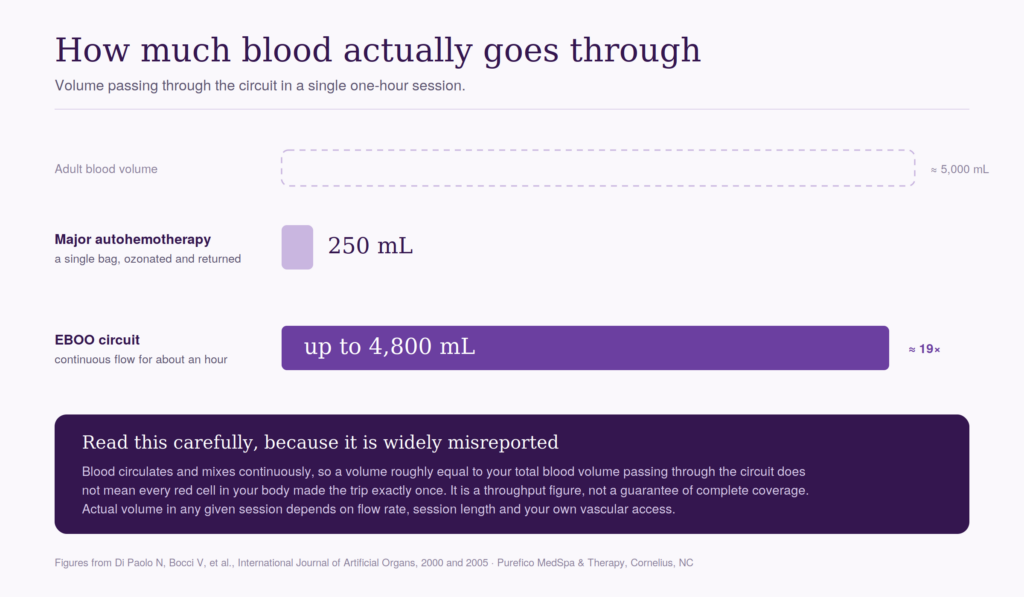
Volume passing through the circuit in a single one-hour session, from the published research.
In the original research by Di Paolo, Bocci and colleagues, the apparatus was able to pass up to 4,800 mL of heparinized blood through the circuit during one hour of extracorporeal circulation. By comparison, conventional major autohemotherapy, the “bag” method, treats roughly 250 mL. That is the genuine difference between EBOO and standard ozone therapy: throughput.
Now the caveat that almost nobody publishes. An adult’s total blood volume is around 5,000 mL, so 4,800 mL through the circuit sounds like “all of your blood.” It is not the same thing. Blood mixes continuously as it circulates, so a throughput figure roughly equal to your blood volume does not mean every red cell made the trip exactly once. Some will have passed through more than once. Some not at all. Actual volume in a given session also depends on flow rate, session length, and how well your veins cooperate on the day.
If a clinic tells you it filters all of your blood, they are rounding a throughput number into a claim it does not support.
What the research actually shows
Here is the honest state of the evidence, and it is thinner than the marketing around this therapy suggests.
EBOO was developed in Italy from around 1990 by a research group at Siena, principally Nicola Di Paolo and Velio Bocci. Their 2000 preliminary report in the International Journal of Artificial Organs described the technique after in-vitro work, animal work, and an early human series.
The one piece of controlled clinical evidence is their 2005 randomized trial, also in the International Journal of Artificial Organs. Twenty-eight patients with peripheral artery disease received either EBOO or intravenous prostacyclin. The EBOO group showed significantly greater regression of skin lesions, along with differences in pain, itching, heaviness in the legs, and general well-being.
Read that carefully:
- 28 patients. That is a small study, and small studies are unreliable predictors of what happens at scale.
- One condition. Peripheral artery disease. Not chronic fatigue, not Lyme, not autoimmune disease, not “detox.”
- Two decades on, it has not been replicated at scale. A registered trial in ischaemic cardiovascular patients followed, but the field never produced the large multi-center evidence base you would want.
- Same research group. Independent replication is what turns a promising finding into an established one, and that has not happened here.
There is also a body of laboratory work on what happens to blood after a session, showing measurable shifts in oxidative-stress markers without appreciable rupture of red cells. That supports the idea that something biologically real is occurring. It does not establish that the something is clinically useful for any particular condition.
So: promising early work, one small positive trial in one vascular condition, and a large gap between that and how the therapy is commonly marketed. Anyone who tells you EBOO is “proven” for a long list of conditions is describing hope, not literature.
Where EBOO stands with the FDA
Plainly: ozone therapy is not FDA-approved, and EBOO is not an FDA-approved procedure.
Under 21 CFR 801.415, the FDA’s stated position is that ozone is a toxic gas with no known useful medical application in specific, adjunctive, or preventive therapy, and it prohibits ozone’s use in any medical condition for which there is no proof of safety and effectiveness. No ozone-generating device holds FDA approval for therapeutic use in people.
What that means in practice is that EBOO is offered within the practice of medicine, at the discretion of a licensed clinician, and that patients pay out of pocket. What it does not mean is that the FDA has reviewed it and found it acceptable, because it has not.
You are entitled to that sentence before you spend money, and we would rather you read it here than find it later and wonder why we skipped it.
What a session at Purefico involves
The Purefico protocol, from seven days before treatment through the 48 hours afterward.
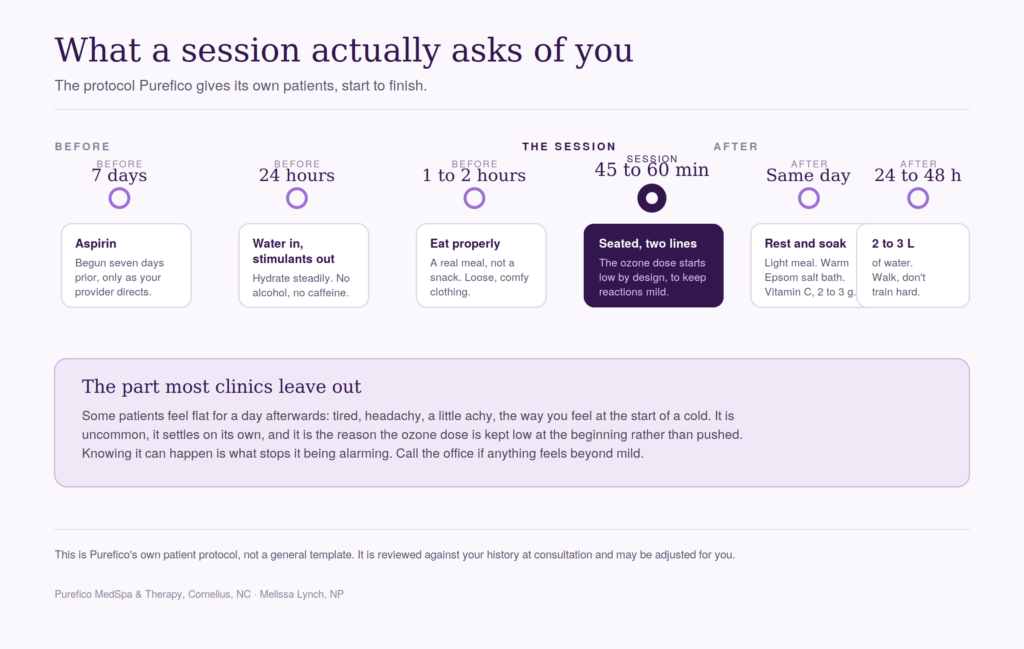
In the week before. Aspirin beginning seven days prior, only as directed by your provider, and only after we have reviewed your medications and history. Do not start this on your own.
The day before. Hydrate steadily. No alcohol and no caffeine for 24 hours.
On the day. A proper meal one to two hours beforehand, not a snack. Wear loose, comfortable clothing with sleeves that push up easily.
During. Two IV lines, a recliner, 45 to 60 minutes. Bring something to read. We start every patient at a low ozone dose rather than an aggressive one. That is a deliberate choice, and it is the single most important thing about how we run this protocol.
Afterwards. Rest for the remainder of the day. A light meal. A warm Epsom salt bath. Vitamin C, 2 to 3 grams on treatment days, checked against anything else you take. Then 2 to 3 liters of water across the following 24 to 48 hours, light walking encouraged, nothing strenuous.
Full detail in how to prepare for your first EBOO session and EBOO aftercare.
A note from Melissa
In 28 years of practice, the thing I have learned to care about most is not how much of anything I can give someone. It is how well they tolerate it. With ozone, the temptation is to reach for a big dose, because a big dose sounds impressive. We do the opposite. We start low, and we build slowly, and the result is that the flu-like day people brace themselves for mostly does not arrive. The patients who have a hard time with this therapy are almost always the ones who were started too high somewhere else.
Melissa Lynch, NP
MELISSA, PLEASE ADD: one specific, non-identifying example here would make this section considerably stronger. Something you actually see. A common first-session reaction, a question patients always ask, a mistake people arrive having made. Two or three sentences is enough.
How many sessions, and what it costs
Sessions. A single treatment is not the therapy. We recommend a course of at least five, with the exact number and spacing built around what we are working on with you. Anyone promising a transformation from one session is selling something.
Cost. A single EBOO session at Purefico is $1,500. Because a course is what actually matters, we price in packages, and package pricing runs 30 to 40 percent below the single-session rate depending on the plan. Pricing is set individually at consultation.
Insurance. Because EBOO is not FDA-approved, it is not covered. This is self-pay. We do offer payment plans.
Details on EBOO therapy cost and how many EBOO sessions you need.
Who should not have EBOO?
Screening is not a formality. Some people should not have this therapy at all.
A history of blood clots is a clear exclusion at our clinic. Beyond that, candidacy depends on your medications, your bleeding risk, your cardiac and thyroid history, and whether you are pregnant. That assessment happens at consultation with a clinician who has your full history in front of them, and it is not something a web page can do for you.
If a provider is willing to book you for EBOO without reviewing your medication list, that is the moment to leave.
Full details on EBOO contraindications and whether EBOO therapy is safe.
How to think about whether it is for you
A reasonable way to hold this:
EBOO is a real procedure with a coherent proposed mechanism, early clinical work behind it, and a genuine evidence gap between that work and its current marketing. It is not approved, not covered, not cheap, and not a substitute for treatment of a diagnosed condition. Some people find it worthwhile. Some do not.
What should make you more comfortable: a licensed clinician who screens you properly, a protocol that starts conservatively, published pricing, and a provider who will tell you what the evidence does not show.
What should make you less comfortable: a long list of conditions presented as treatable, a claim that the therapy is proven or FDA cleared, pressure to buy a large package on a first visit, or anyone unwilling to say the word “unapproved” out loud.
If you are weighing this up, book a consultation and bring your medication list and your skepticism. Both are useful.
Frequently asked questions
What does EBOO stand for?
Extracorporeal blood oxygenation and ozonation. “Extracorporeal” simply means outside the body. The blood is treated in an external circuit and returned.
Is EBOO therapy FDA approved?
No. The FDA classifies ozone as a toxic gas with no known useful medical application and has not approved any ozone device for therapeutic use in people. EBOO is offered within the practice of medicine and is paid for out of pocket.
How long does an EBOO session take?
About 45 to 60 minutes of treatment time. Allow longer for your first visit, which includes consultation and IV placement.
Does EBOO hurt?
The procedure itself is not painful. You will feel two IV insertions, comparable to giving blood. Most patients read or work through the session.
How many EBOO sessions will I need?
We recommend a course of at least five. The precise number and spacing are set at consultation.
How much does EBOO cost?
$1,500 for a single session at Purefico. Package pricing runs 30 to 40 percent below that rate depending on the plan, and is quoted individually.
What are the side effects?
Most people feel fine. Some feel tired, headachy, or mildly achy for a day, similar to the onset of a cold. It is uncommon and self-limiting, and starting at a low ozone dose is how we keep it that way. Contact the office if anything feels beyond mild.
Is EBOO the same as a 10-pass ozone treatment?
No. A 10-pass treats a fixed volume of blood repeatedly in cycles. EBOO runs blood continuously through a filter circuit, so the total volume passing through is far larger.
Who should not have EBOO?
Anyone with a history of blood clots, and others depending on medications, bleeding risk, cardiac and thyroid history, and pregnancy status. Screening is done individually.
Is EBOO available near Charlotte?
Yes. Purefico MedSpa & Therapy is in Cornelius, NC, in the Lake Norman area, roughly 20 miles north of uptown Charlotte, with a second location in Archdale.
References
- Di Paolo N, Bocci V, Salvo DP, et al. Extracorporeal blood oxygenation and ozonation (EBOO): a controlled trial in patients with peripheral artery disease. International Journal of Artificial Organs. 2005;28(10):1039-1050.
- Di Paolo N, Bocci V, Garosi G, et al. Extracorporeal blood oxygenation and ozonation (EBOO) in man: preliminary report. International Journal of Artificial Organs. 2000;23:131-141.
- Bocci V, Di Paolo N. Extracorporeal blood oxygenation and ozonation: clinical and biological implications of ozone therapy. Redox Report. 2005.
- S. Food and Drug Administration. 21 CFR 801.415, Maximum acceptable level of ozone.