No, insurance does not cover EBOO therapy. Because ozone is not FDA-approved, insurers classify EBOO as investigational or alternative medicine, which places it outside standard reimbursed care. It is a self-pay treatment. The practical ways people fund it are HSA or FSA accounts, an out-of-network superbill you submit yourself, and clinic payment plans. Reimbursement through a superbill is possible with some PPO plans but is genuinely rare, so it is best treated as a bonus rather than something to rely on.
That is the honest answer. This article explains exactly why EBOO is not covered, walks through each realistic payment route including the HSA and FSA rules that actually matter, and covers the tax angle most pages ignore. EBOO is not FDA-approved, and this is general information, not tax, insurance, or medical advice.
- Standard health insurance does not cover EBOO therapy, because it is classified as investigational or alternative medicine.
- HSA and FSA funds can often be used, but eligibility depends on your specific plan, so confirm with your administrator first.
- A superbill lets you attempt out-of-network reimbursement yourself. For an investigational therapy like EBOO, success is rare, so do not count on it.
- Many clinics, including Purefico, offer payment plans so a full course does not have to be paid all at once.
- EBOO may qualify as a deductible medical expense on your taxes if you itemize, though thresholds apply. Ask a tax professional.
- EBOO is not FDA-approved. Every honest clinic gives the same coverage answer, because the reason is regulatory, not clinic-specific.
Is EBOO Therapy Covered by Insurance?
The short answer is no. So does insurance cover EBOO therapy in any standard plan? Not one, and it is worth being clear about that before you spend anything. No major United States health insurer covers EBOO therapy. This is not a case of one clinic failing to bill correctly, and shopping around will not find you a plan that covers it. The reason is regulatory and applies across the board, which is why every honest provider gives the same answer.
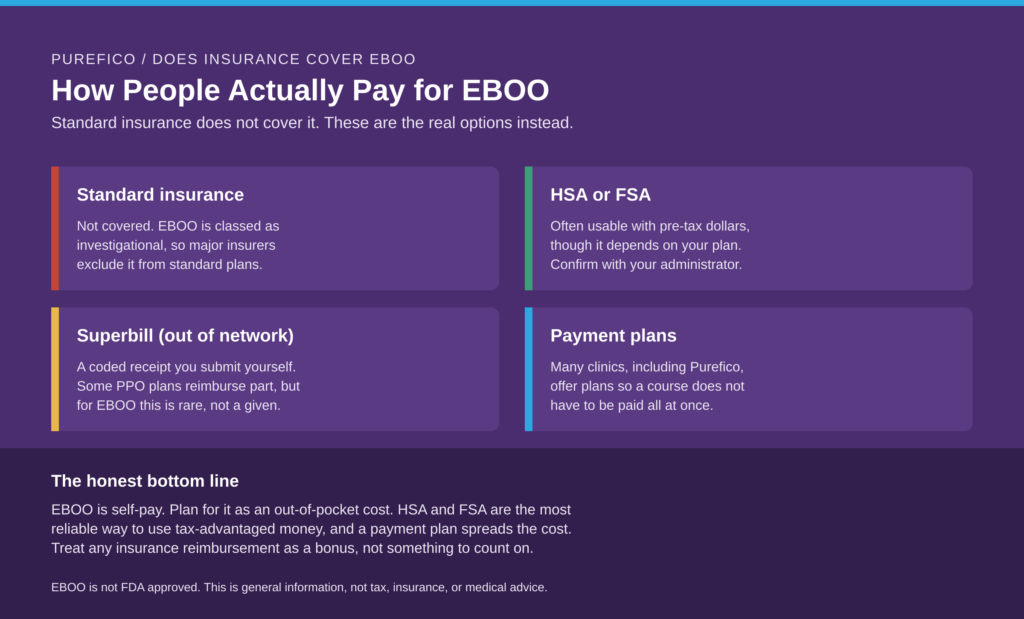
What that means in practice is simple. When patients ask whether insurance covers EBOO therapy, the useful follow-up is not whether insurance will pay, but which of the remaining routes fits best, because EBOO is a self-pay treatment.
Why Insurance Will Not Cover EBOO Therapy?
The reason EBOO is not covered follows a clear chain, and understanding it saves you time arguing with a benefits line that will never say yes.
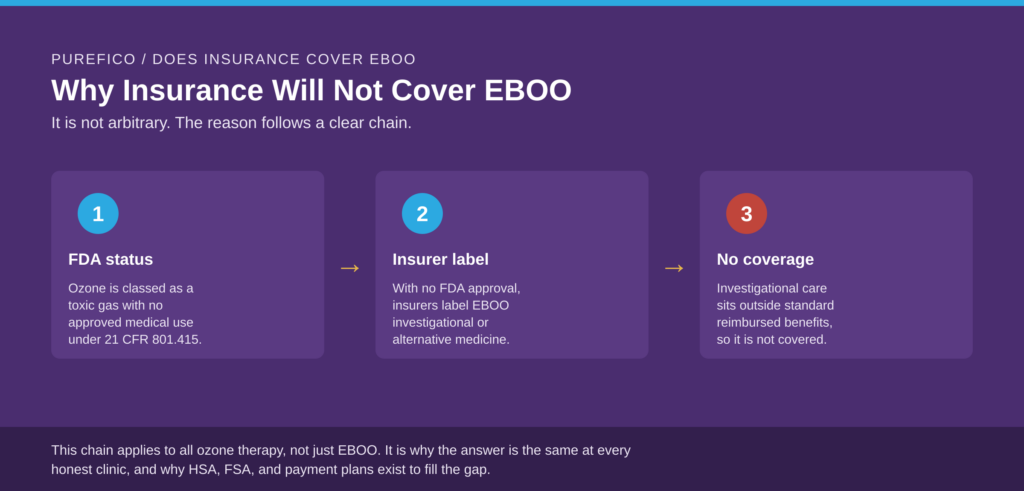
The chain is that direct, and it applies to all ozone therapy, not only EBOO. So when you ask whether insurance covers EBOO therapy, the honest answer traces straight back to that FDA classification.
Can You Use an HSA or FSA for EBOO?
This is the most reliable way to use tax-advantaged money for EBOO, and it is where the useful nuance lives. Health Savings Accounts and Flexible Spending Accounts let you spend pre-tax dollars on qualified medical expenses, and ozone therapy can qualify with many plans. But it is not automatic.
- Eligibility depends on your plan: Some administrators approve EBOO without question; others ask for documentation. Confirm before you assume it is covered.
- A Letter of Medical Necessity may help: If your provider documents why the treatment is recommended for you, some plans are more willing to allow the expense.
- Keep your receipts: HSA and FSA spending can be audited, so hold on to itemized receipts and any provider documentation.
At Purefico, we can provide the documentation you need to submit to your HSA or FSA administrator. The final decision always rests with the administrator, not the clinic.
What Is a Superbill, and Will It Get EBOO Reimbursed?
You will see some clinics describe a superbill as a way around the coverage problem. Here is the honest version. A superbill is a detailed, coded medical receipt, including procedure codes and diagnosis codes, that you can submit to your own insurer to request out-of-network reimbursement.
It is a real option, and worth trying if you have strong out-of-network PPO benefits. But set your expectations accurately. Because EBOO is classified as investigational, most insurers deny these claims, and the patients who do recover something usually recover only part of the cost. Treat a superbill as a long shot that costs you nothing to attempt, not as a reason to expect your money back. A provider who presents it as a reliable loophole is overselling it.
Is EBOO Therapy Tax Deductible?
This is the angle almost no clinic mentions. Beyond an HSA or FSA, the IRS allows a deduction for qualified unreimbursed medical expenses if you itemize and your total medical costs pass a percentage-of-income threshold. Ozone therapy provided by a licensed provider may count toward that total.
Whether it helps you depends entirely on your overall tax situation, so this is a question for a tax professional, not a clinic. We mention it only because it is a legitimate route that the standard “no, but HSA/FSA” answer leaves out.
How to Plan for the Cost of EBOO?
Since the answer to ” Does insurance cover EBOO therapy is no, EBOO is self-pay, and a little planning goes a long way. A sensible approach:
- Ask the clinic for the total cost of a course, not just the price of one session, so there are no surprises.
- Check HSA or FSA eligibility with your plan administrator before you start.
- Ask whether the clinic offers payment plans, so the cost can be spread out.
- If you have out-of-network PPO benefits, request a superbill and submit it, while treating any reimbursement as a bonus.
- Keep every itemized receipt in case you itemize medical expenses at tax time.
For the actual numbers, our full breakdown of EBOO therapy cost covers single-session and package pricing. If you are still weighing the treatment itself, it also helps to read whether EBOO therapy is safe and how many sessions you need so the total cost is in context.
A Note From Melissa
When someone asks me Does insurance cover EBOO therapy?, I would rather give them the plain truth about cost than let them make a hopeful phone call to their insurer first.
Frequently Asked Questions
Does insurance cover EBOO therapy?
No. Standard health insurance does not cover EBOO therapy because it is classified as investigational or alternative medicine, which places it outside standard reimbursed care. EBOO is a self-pay treatment.
Is EBOO therapy covered by insurance if I have a PPO?
Not directly, even with a PPO. You can request a superbill and submit it for possible out-of-network reimbursement, but because EBOO is investigational, most claims are denied, and any reimbursement is usually partial. Treat it as a long shot.
Can I use my HSA or FSA to pay for EBOO?
Often yes. HSA and FSA funds can typically be used for ozone therapy, but eligibility depends on your specific plan. Confirm with your plan administrator first, and ask your provider for documentation such as a Letter of Medical Necessity if needed.
What is a superbill for EBOO?
A superbill is an itemized medical receipt with procedure and diagnosis codes that you submit to your own insurer to request out-of-network reimbursement. For EBOO, success is rare because the therapy is classified as investigational.
Why is EBOO not covered when other IV treatments are?
Because ozone is not FDA approved for therapeutic use. Insurers cover treatments that are FDA approved and considered standard of care. EBOO does not meet that bar, so it is excluded along with all other ozone therapy.
Is EBOO tax deductible?
It may be. The IRS allows a deduction for qualified unreimbursed medical expenses if you itemize and pass an income threshold, and ozone therapy from a licensed provider may count. Ask a tax professional about your situation.
Does insurance cover EBOO near Charlotte, NC?
No. At Purefico in Cornelius, NC, near Charlotte, EBOO is self-pay like everywhere else, but we accept HSA and FSA, provide superbills on request, and offer payment plans to make a course manageable.
References
- U.S. Food and Drug Administration. 21 CFR 801.415, Maximum acceptable level of ozone.
- Internal Revenue Service. Publication 502, Medical and Dental Expenses. (Qualified medical expense deduction and itemization threshold.)
- Internal Revenue Service. Publication 969, Health Savings Accounts and Other Tax-Favored Health Plans.

Medical Disclaimer: This article is for educational purposes only and does not constitute medical advice. Hormone therapy and wellness treatments should only be initiated after consultation with a qualified healthcare provider and appropriate laboratory evaluation. Individual results vary. If you are experiencing a medical emergency, seek immediate medical attention.