The side effects of EBOO therapy are usually mild and temporary. The most common are tiredness, a mild headache, a light flu-like feeling, brief nausea or a metallic taste during reinfusion, slight lightheadedness, and minor bruising at the IV site. Most resolve on their own within 24 to 48 hours. Serious side effects are rare.
In the published literature, the overall rate of adverse events from ozone therapy has been estimated at around 0.0007 percent, one of the lowest in medicine, and side effects drop further when the ozone dose is started low and increased slowly.
EBOO is not FDA approved, and this article is educational, not medical advice. Below we cover each common side effect and when it tends to appear, the rare serious risks, who is more likely to react, the honest truth about the “detox” explanation many clinics give, and how to make your session as smooth as possible.
- Most EBOO side effects are mild and pass within 24 to 48 hours. The most common is short-lived tiredness.
- Nausea or a metallic taste during reinfusion is reported more often by women, in roughly 10 to 15 percent of cases in one long-running clinical series.
- Serious complications are rare. Overall ozone therapy adverse events have been estimated at about 0.0007 percent, among the lowest in medicine.
- Side effects are largely dose-dependent. Starting at a low ozone dose and building slowly is what keeps them to a minimum.
- The tired, flu-like day is often called a “detox” reaction. That is a proposed explanation, not a proven one. What matters is that it is usually mild and self-limiting.
- EBOO is not FDA-approved. Proper screening, including for G6PD deficiency, is what prevents the rare serious reactions.
Common EBOO Therapy Side Effects
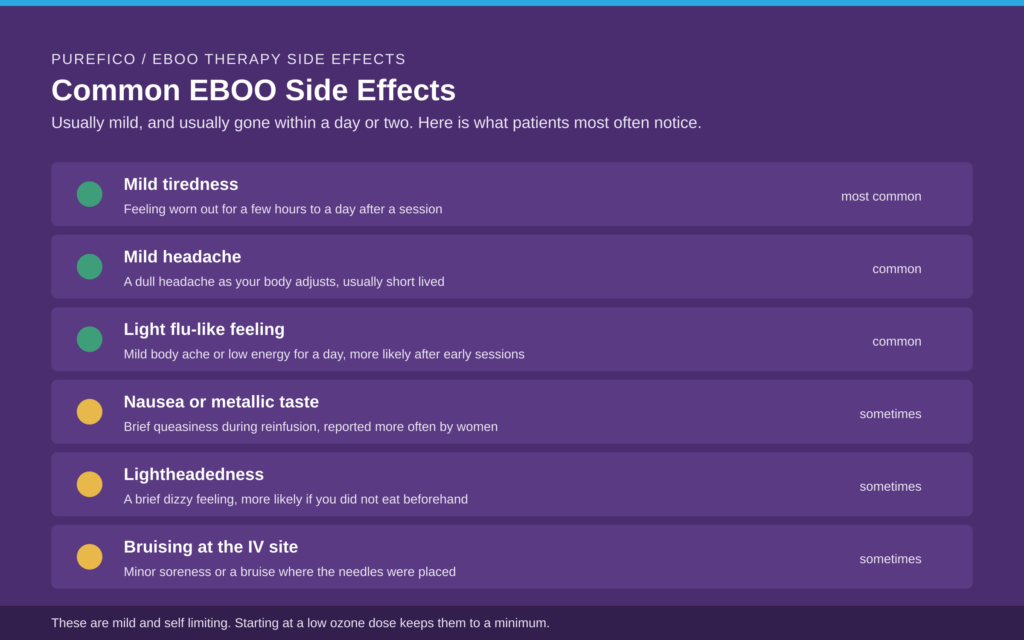
For most people, EBOO is a smooth experience and any side effects are gentle. Here are the reactions patients most often report, and when each one tends to show up.
Mild Tiredness
The single most common effect. Many people feel a little worn out for a few hours to a day after a session, especially after their first few. It usually lifts on its own with rest.
Mild Headache
A dull, mild headache can show up the same day as your body adjusts. Staying hydrated before and after your session helps, and it typically passes within a day.
Light Flu-Like Feeling
Some people feel slightly achy or under the weather for a day, most often after the earliest EBOO sessions. It tends to ease as you continue, and it is usually mild.
Nausea or a Metallic Taste
A brief wave of nausea, stomach bloating, or a strange metallic taste can happen during the reinfusion part of the session. Interestingly, in the longest-running clinical series, this was reported more often by women, in roughly 10 to 15 percent of cases, and it was linked to how quickly the blood was returned. A slower reinfusion reduces it.
Lightheadedness
A brief dizzy or faint feeling is possible, and it is more likely if you came in without eating. This is one of the easiest side effects to prevent, which we cover below.
Bruising or Soreness at the IV Site
Because EBOO uses a line in each arm, some minor bruising or tenderness where the needles were placed is normal, the same as after a blood draw. A warm compress helps.
When EBOO Side Effects Appear and How Long They Last
Knowing the rough timing takes a lot of the worry out of the experience. Here is the general pattern, though individual timing varies.
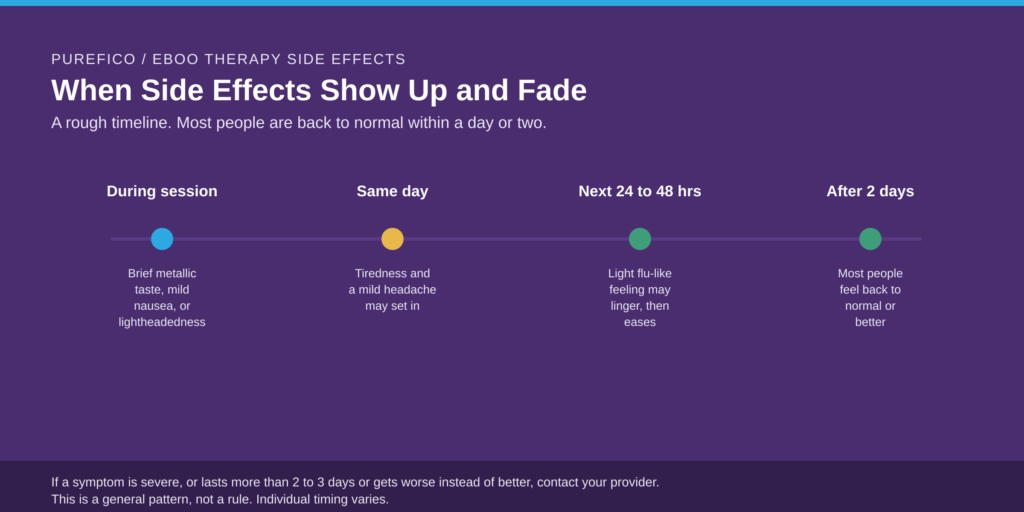
During the session, the only things you might notice are a brief metallic taste, mild nausea, or slight lightheadedness. Later the same day, tiredness and a mild headache are the usual visitors. Over the next 24 to 48 hours, a light flu-like feeling may linger and then ease. After about two days, most people feel back to normal, and many feel better than they did before. If a symptom is severe, lasts beyond two to three days, or gets worse rather than better, that is your cue to contact your provider.
The Truth About EBOO “Detox” Reactions
Here is where we differ from a lot of what you will read online, and we think the honesty matters. Many clinics describe the tired, achy day after EBOO as a “detox” or Herxheimer reaction, and frame it as proof the therapy is working by killing off pathogens and releasing toxins.
Be a little cautious with that framing. The detox or die-off explanation is a proposed mechanism, not a proven one, and no one should tell you that feeling worse is a reliable sign the treatment is succeeding. What is actually well supported is simpler and more reassuring: the ozone in EBOO creates a brief, controlled oxidative challenge, and the mild, short-lived symptoms some people feel afterward are the body responding to that.
Calling it “detox” does not change what you should do about it, and it should never be used to wave away a symptom that is genuinely severe or lasting. Our approach is to tell you what we actually know, treat the mild day as mild, and take anything beyond that seriously rather than reframing it as a good sign.
Why Are Side Effects Mostly About Dosing?
One of the most useful facts about EBOO side effects almost never makes it into these articles: they are largely dose dependent. In the clinical work that first documented EBOO and related ozone therapy, side effects like the tired day and the nausea were common when patients were started at a high fixed ozone dose. When the same clinicians switched to a “start low, go slow” approach, beginning at a low dose and scaling up gradually, those side effects largely disappeared.
This is why the clinic you choose matters as much as the EBOO therapy itself. A provider who starts everyone at an aggressive dose to seem powerful is also the provider whose patients have the hardest time. We start low on purpose. It is better medicine, and it is a better experience.
Who Is More Likely to Have Side Effects?
Reactions are usually mild for everyone, but some people are a little more likely to feel them:
- People new to ozone or IV therapy, especially in the first few sessions
- Anyone who comes in without eating, which makes lightheadedness and low blood sugar more likely
- People who are dehydrated going into the session
- Those dealing with a heavy chronic illness burden, who may feel the flu-like effect more
- Women, who reported the reinfusion nausea and metallic taste more often in clinical series
None of this means EBOO is unsafe for these groups. It means preparation matters, which is the next section.
Rare but Serious EBOO Side Effects
Being straight about the serious risks is what separates real information from a sales page. These are uncommon, and proper screening is designed to prevent them, but you deserve to know they exist.
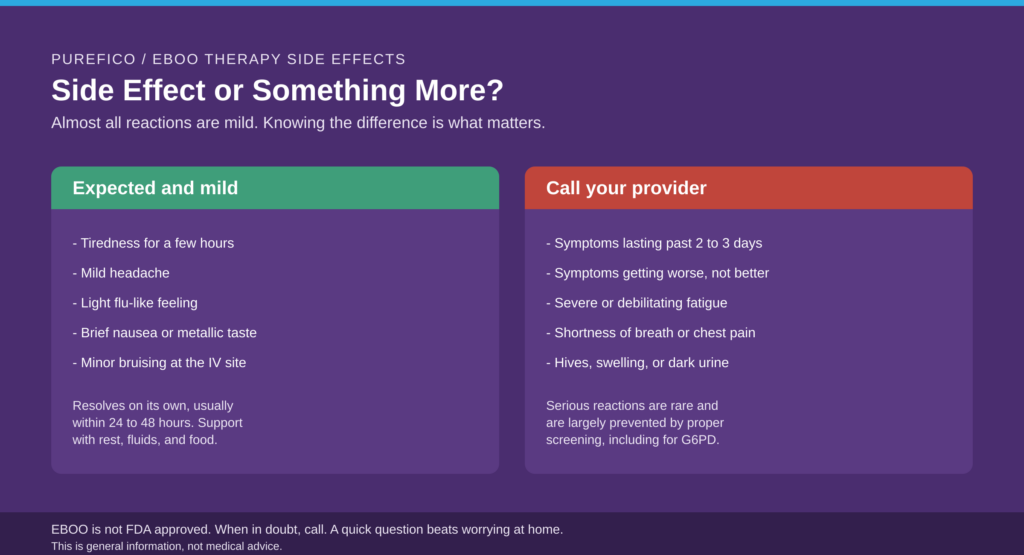
Hemolysis (red blood cell breakdown): The most important serious risk, and the reason G6PD deficiency must be screened for. People with this genetic enzyme condition cannot handle the oxidative stress of ozone well. Screening prevents it.
A drop in blood pressure: A temporary dip can happen, and it is more likely in people on certain blood pressure medications such as ACE inhibitors. This is monitored during the session, and a slower reinfusion reduces it.
Allergic-type reactions: Rare, and historically some were linked to older plastic equipment rather than the ozone itself. Modern closed circuits have made these much less common.
Bleeding or clotting issues: A small amount of anticoagulant keeps blood moving through the circuit, which is managed carefully and is why a history of blood clots is a reason not to have EBOO.
Call your provider promptly for shortness of breath, chest pain, severe or worsening symptoms, symptoms lasting more than two to three days, or signs of an allergic reaction such as hives, swelling, or dark urine.
How to Minimize EBOO Side Effects
Most of the mild side effects are easy to reduce with a little preparation. Here is what actually helps.
Before and after your session
Eat a normal, protein-containing meal a couple of hours before. Do not come in fasted.
Hydrate well the day before and the day of. Dehydration makes the headache and dizziness worse.
Choose a provider who starts at a low ozone dose and builds up, rather than starting aggressively.
Plan a lighter day afterward. Rest and avoid strenuous exercise the day of treatment.
Keep drinking water afterward and eat nourishing, simple food.
Tell your provider about every medication you take, especially blood pressure medicine and blood thinners.
A Note From Melissa
The question I hear most is some version of “should I be worried if I feel tired after?” The honest answer is almost always no. A mild, short day is expected, and it is not a competition to have a dramatic reaction. What I do not want is for anyone to be told that feeling genuinely unwell is a good sign and to push through it. Mild is mild, and anything more than mild is worth a phone call. That is the whole framework.
Frequently Asked Questions
What are the side effects of EBOO therapy?
Common side effects of EBOO include mild tiredness, a mild headache, a light flu-like feeling, brief nausea or a metallic taste during reinfusion, slight lightheadedness, and minor bruising at the IV site. They are usually mild and resolve within 24 to 48 hours.
How long do EBOO side effects last?
Most EBOO side effects last from a few hours up to two days. Tiredness and mild headache tend to show up the same day; a light flu-like feeling may linger for 24 to 48 hours, and most people feel back to normal after about two days.
Is it normal to feel tired after EBOO?
Yes. Mild tiredness is the most common side effect of EBOO and is usually nothing to worry about. It typically passes within a day with rest. If fatigue is severe or lasts more than two to three days, contact your provider.
Are EBOO side effects a sign it is working?
Not reliably. Many clinics describe post-session tiredness as a “detox” sign, but that is a proposed explanation rather than a proven one. Feeling mildly tired is common, but you should not treat feeling unwell as proof the therapy is succeeding, and severe symptoms are never a good sign.
How can I reduce EBOO side effects?
Eat a meal beforehand, hydrate well before and after, choose a provider who starts at a low ozone dose and builds up slowly, and plan a restful day afterward. These steps prevent most of the mild side effects.
Are there any serious side effects of EBOO?
Serious side effects are rare. The main one is hemolysis in people with G6PD deficiency, which is why screening for it is essential. Others include a temporary blood pressure drop and, rarely, allergic-type reactions. Overall, ozone therapy adverse events have been estimated at about 0.0007 percent.
Is EBOO therapy safe near Charlotte, NC?
Purefico in Cornelius, NC, in the Lake Norman area about 20 miles north of uptown Charlotte, provides EBOO with full screening, a conservative low-to-high dosing approach that minimizes side effects, and a licensed clinician present throughout every session.
References
- Bocci V. The clinical application of ozonetherapy. In: OZONE: A new medical drug. Dordrecht: Springer; 2011. (Side effects, incidence, and contraindications of systemic ozone therapy, including AHT and EBOO.)
- Di Paolo N, Bocci V, Salvo DP, et al. Extracorporeal blood oxygenation and ozonation (EBOO): a controlled trial in patients with peripheral artery disease. International Journal of Artificial Organs. 2005;28(10):1039-1050.
- Jacobs MT. Untersuchung über Zwischenfälle und typische Komplikationen in der Ozon-Sauerstoff-Therapie. OzoNachrichten. 1982;1:5. (Original adverse event incidence data.)
- Cacciatore S, et al. Effectiveness and safety of ozone therapy in humans: an umbrella review. Medical Sciences. 2026;14(2):289.
- U.S. Food and Drug Administration. 21 CFR 801.415, Maximum acceptable level of ozone.

Medical Disclaimer: This article is for educational purposes only and does not constitute medical advice. Hormone therapy and wellness treatments should only be initiated after consultation with a qualified healthcare provider and appropriate laboratory evaluation. Individual results vary. If you are experiencing a medical emergency, seek immediate medical attention.